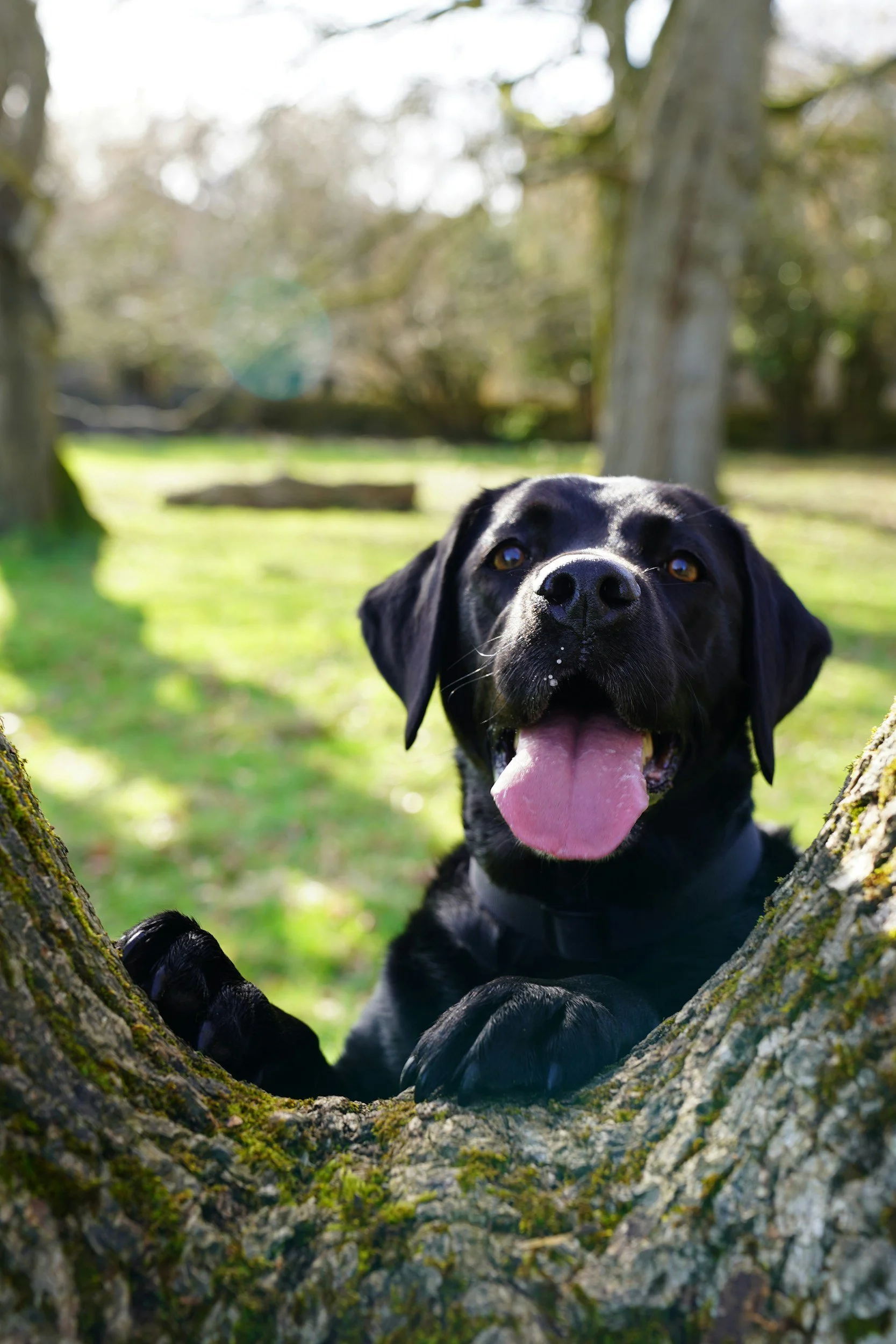
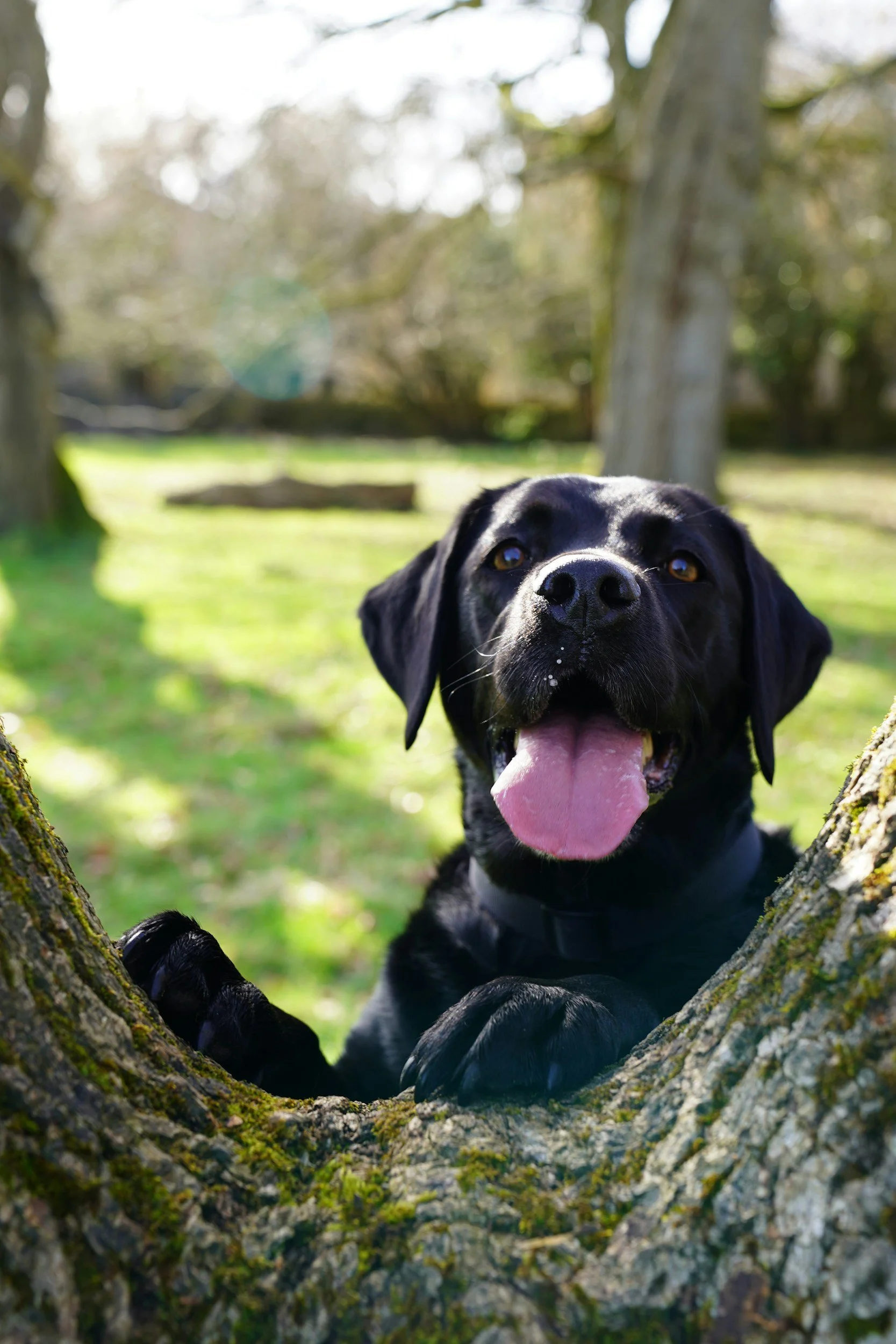
Photo: A black Labrador Retriever peeking in between the fork in a large tree. His mouth is open, so you can see his pink tongue. His paws are up on the tree. He is wearing a navy blue collar.
You and your dog have been working hard to build a solid foundation.
She understands the commands you’ve taught her and can perform them reliably in your home, in training facilities, and in your backyard where there’s more distractions (I’m lookin’ at YOU, squirrels.)
You’d like to work her around more distractions, but you DON’T want off-leash dogs bombing up to you and making your dog feel overwhelmed.
Guelph has some beautiful trails where you can work with your dog, enjoy nature, and avoid the drama of off-leash dogs.
These hidden gems will allow you and your dog to deepen your bond and proof your commands (that’s the fancy way of saying “make sure your dog can do all her commands no matter what distractions are around.”)
If you're looking for dog-friendly trails in Guelph where you can practice walking calmly around distractions, recall, and placework while enjoying nature together, here are a few places to consider — along with some tips for making your training session successful.
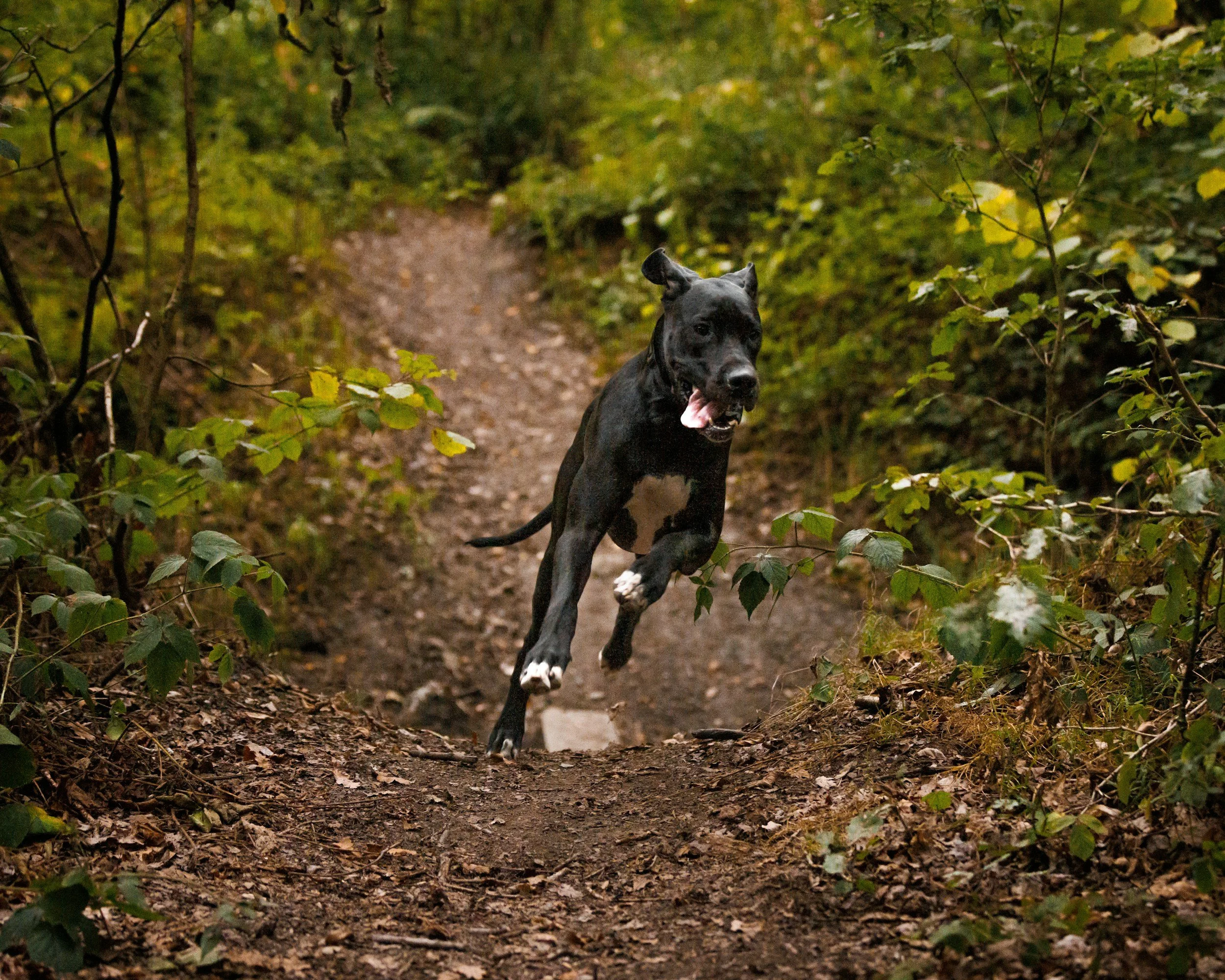
If you want to avoid off-leash dogs bombing toward you while you’re working with your puppy or dog, these Guelph gems will get you the space you need. Photo: A large black and white dog running down a trail toward the camera with its tongue hanging out the side of its mouth.
First: A Training Session Doesn't Look Like a 5 Km Loop
This might surprise you.
When you're training your dog to walk nicely out in public, your goal shouldn’t be to cover as much distance as possible.
You’ll reach your goals faster if you focus on quality, not quantity.
If your dog is pulling, barking at other dogs, lunging at bicycles, or becoming completely overwhelmed by everything around her, walking another five kilometres down the trail isn't going to solve the problem.
Instead, find a nice quiet spot where you can practice your commands at a distance from the trail itself.
From this spot you’ll be able to see dogs, hikers, bicycles, etc, but now you’re at a distance where your dog can listen to you, rather than become overexcited by them. She gets the chance to practice listening to you around distractions, instead of pulling toward them.
Remember to pause and breathe. How you’re feeling matters.
If you brought your dog’s tug toy, this is a great time to take a break for play. Your dog learns so much during play — like how to drop the toy and how to be respectful to get it back vs. jumping on you or demand barking.
If you brought your dog’s place cot, you can practice heeling, place, recall, and tug while the world passes you by at a distance.
You have her whole life to walk in a straight line on a trail. Before she learns how to do that without pulling toward everything, this step needs to be mastered. Who knows — you may enjoy these training sessions a whole lots more than crowded trails.
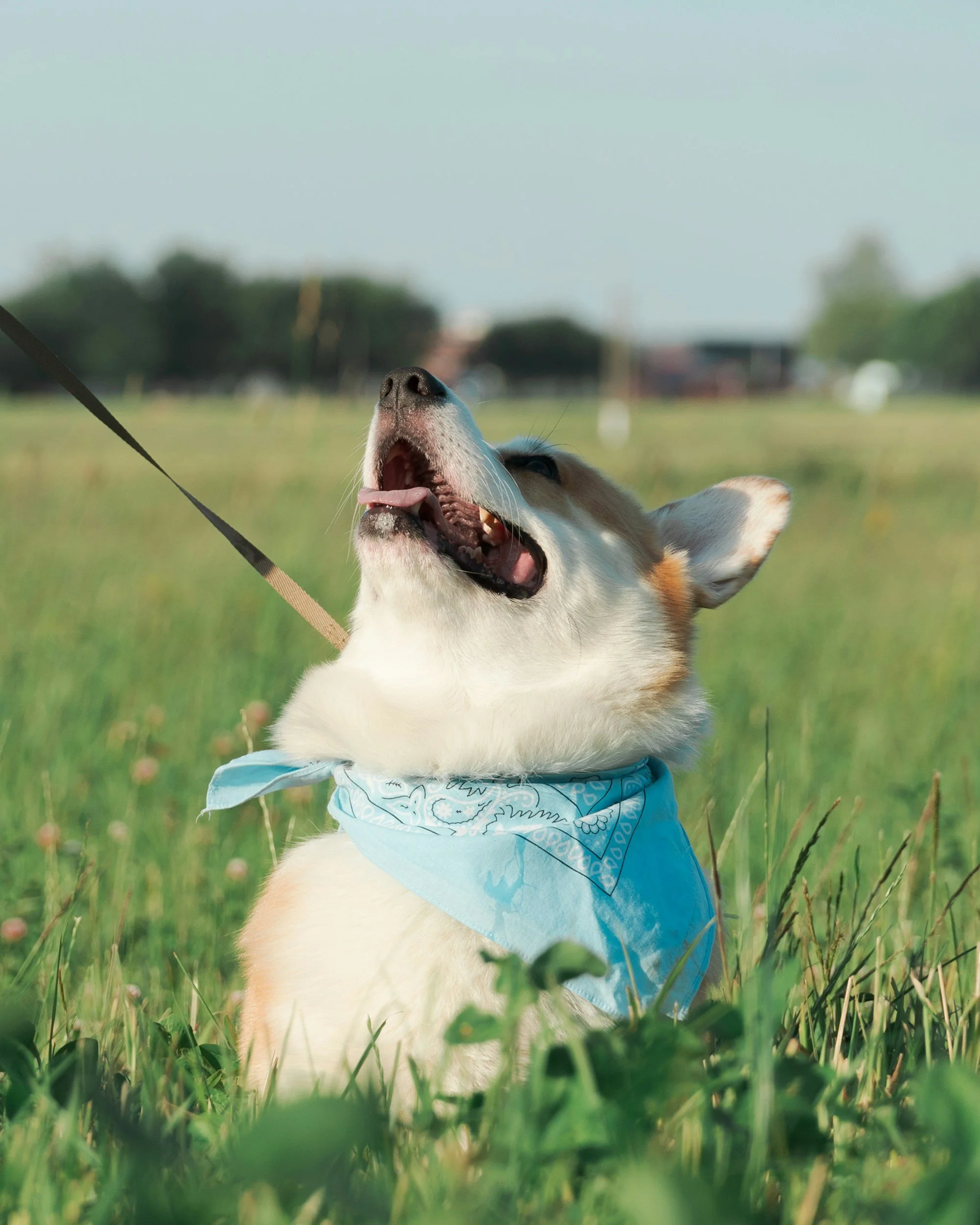
Finding a space where you can engage with your dog at a distance from the distractions will help them learn all about the world, without being overwhelmed by it. Photo: A Corgi wearing a turquoise bandana looks up at the person (off-camera) who is holding the leash.
Speed River Trail
The Speed River Trail is one of Guelph's beautiful places to practice real-world leash walking.
The City of Guelph lists the trail as approximately 3.4 kilometres long, running from Speedvale Avenue East to Victoria Road North through Riverside Park.
Depending on where you enter the trail and when you visit, you may encounter walkers, joggers, bicycles, dogs, wildlife, and plenty of interesting smells.
In other words:
DISTRACTIONS.
And distractions aren't necessarily a bad thing.
They're training opportunities.
If your dog already has some basic leash skills, a trail like this gives you an opportunity to practice those skills somewhere more interesting than your neighbourhood.
When a cyclist approaches, can your dog stay with you?
When another dog passes, can you keep moving without being dragged toward them?
When a squirrel makes the questionable decision to run directly across your path, can your dog recover and continue walking?
These are the skills that make life with your dog enjoyable.
Just remember that your goal isn't perfection.
It's progress.
If your dog is reactive, you’ll want a nice spot away from the narrow trails to practice. During the day, when there’s no one playing disc golf, you’ll find that area to be a lovely distance away from the dog walkers on the sidewalk (on Riverview Drive) and the bikes and joggers on the trail by the river. You can find street parking, or use the little parking lot that’s near the fire station. This time of year, you’ll enjoy beautiful fall colours.
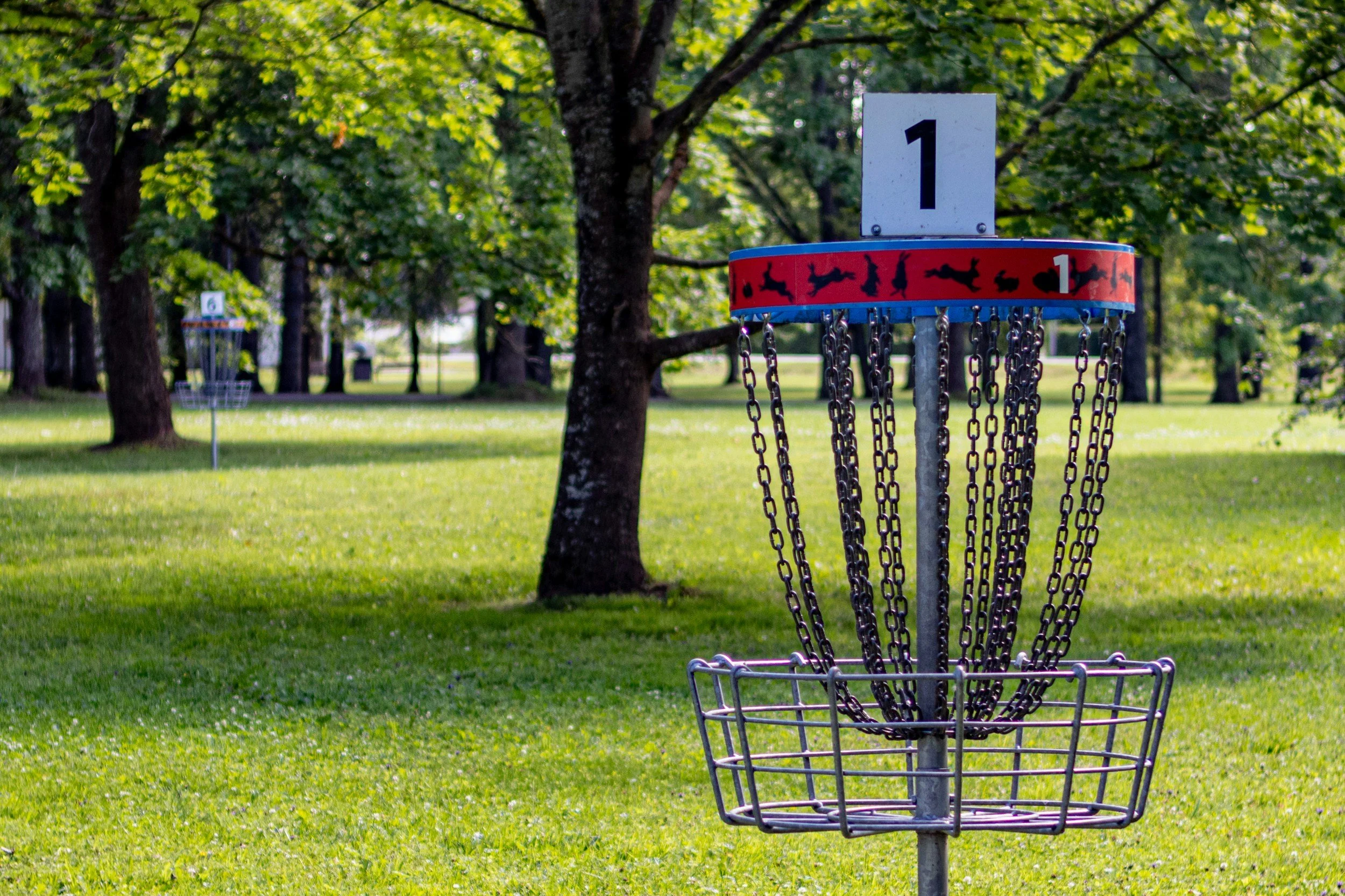
There’s lots of space around the disc golf course to work with your dog on-leash. Photo: A disc golf course with lots of grass and trees in the background.
Eramosa River Trail
Another beautiful option is the Eramosa River Trail. It’s about 4.1 kilometres long and stretches from the Gordon Street covered bridge (near York Road Park) east to Stone Road, passing through Eramosa River Park and crossing Victoria Road South.
A trail with natural sights, sounds, wildlife, people, and dogs can be a wonderful training environment for a dog who is ready for that level of distraction.
If you and your dog benefit from a little more space, instead of training close to Victoria road (near the volleyball courts,) train closer to the covered bridge. You can park on York and practice being calm on the soccer field as distractions flow by on the trail that runs along the river.
Tip: When you’re working around distractions, you’re searching for the distance between you and the distraction where your dog can still listen and take direction from you. If your dog is ignoring you when you’re 25 feet away from the trail. Try moving to 30 feet. If that doesn't work. Try 35. Don’t get discouraged. It can help to think of it this way: your dog is providing you with information. It has nothing to do with you being a good dog owner (or trainer.) The dog in front of you today, in this moment, needs a bit more space in order to take guidance from you. The next day, she could need more or less. One day, if you’re consistent, that distance will shrink and you’ll be able to look back on these days fondly. Until then, keep at it. You can do it.
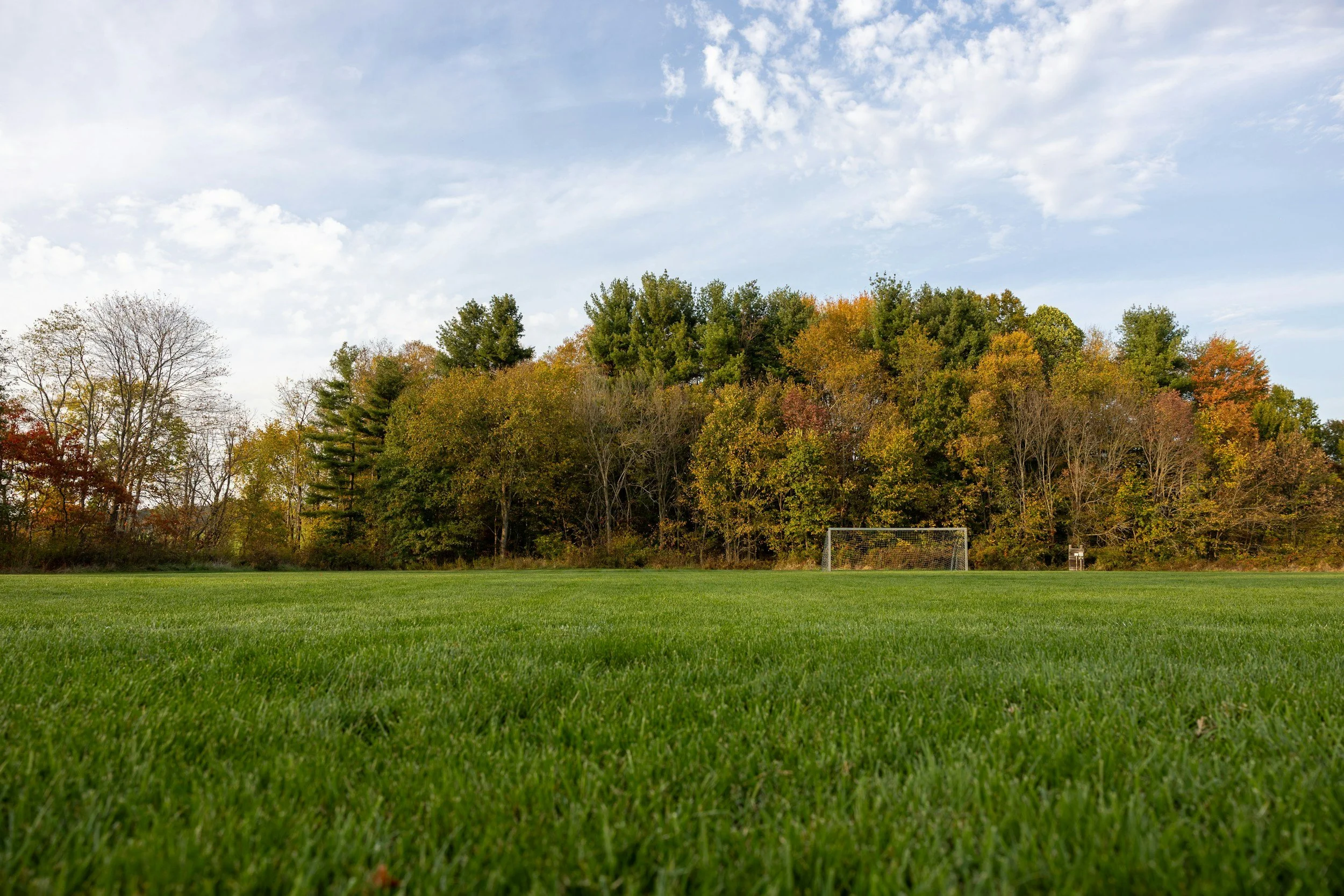
You’ll be able to see the covered bridge and the trail from the soccer field while you practice engagement activities with your dog. Photo: A soccer field with a copse of trees behind it.
University of Guelph Arboretum
The Arboretum is another option in the Guelph area if you and your dog enjoy being in nature.
It’s very rare to see a dog off-leash here (because dogs are required to be on-leash) and if you do, the sight-lines are so good that you can usually avoid running into it by creating space.
If you’re in the early stages of training your puppy or dog, avoid the narrow trails (unless you fancy trying to pass a reactive dog on a flexi-leash when you’re on a boardwalk with water on both sides of you.)
There are so many amazing green spaces to choose from where you can focus on your dog learning skills like recall and heel while all sorts of distractions pass by on the trails. You’ll see things like strollers, gardeners driving around in motorized vehicles, bikes, joggers, and lots of wildlife.
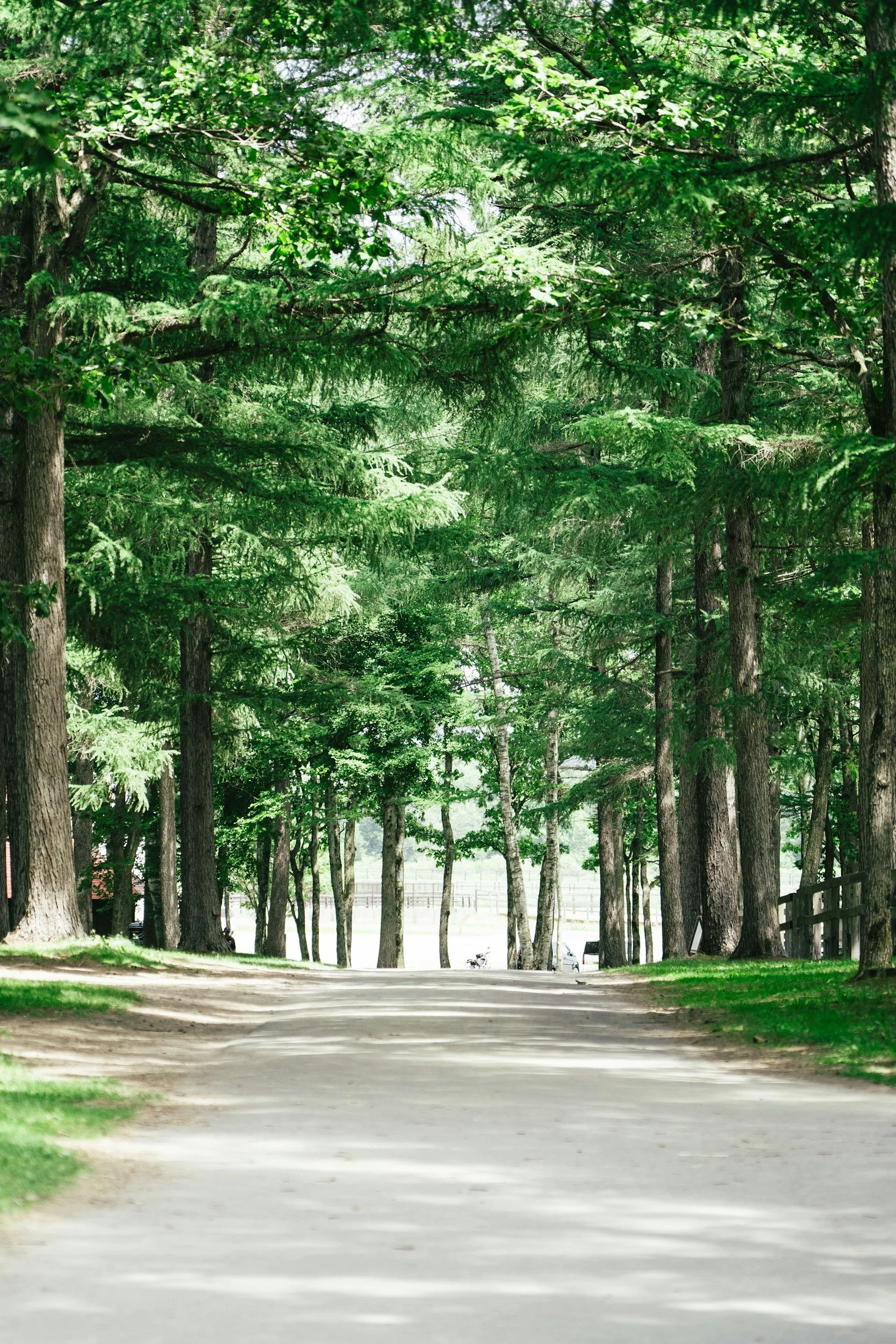
There’s so many nice spots on the lawn at the Arboretum where you can work with your dog as distractions go by at a distance. Photo: a wide trail lined with conifers. There is dappled sunlight on the trail.
What Should You Practice on Guelph Trails?
A lot of owners end up in trouble when they unclip their dog’s leash too soon. I’ve had owners call me after their dog has:
-gone missing for hours (and sometimes days) after taking off on a hike
-been in a fight with another dog
-almost been hit by a car
-bit a stranger who tried to catch them
Off-leash life begins on the leash.
Most owners don’t realize that you can keep a leash on while teaching:
-recall
-drop
-polite manners during tug and fetch
-and more
Find a space away from the trail to work on these skills. You’ll have way more fun than trying to weave through pedestrians, bikes, other dogs, etc before you and your dog are ready.
Here are some ideas of things to practice at a distance to the trail (remember: pick the distance that your dog can listen to you.)
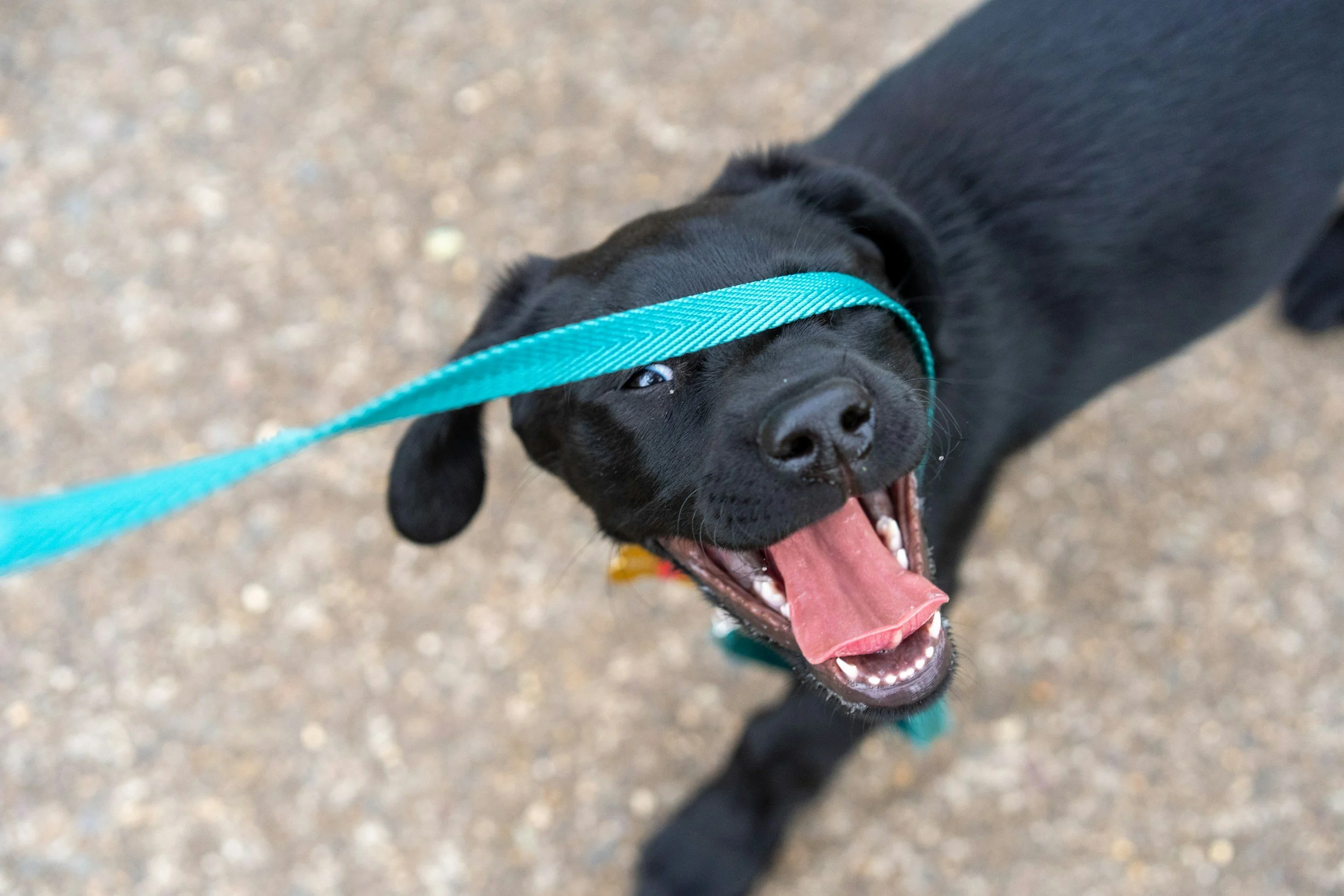
Off-leash life begins on the leash with lots and lots of practice. Photo: A black dog with its turquoise leash draped over its face, covering one and and revealing eye. Its mouth is open and you can see its tongue and bright white teeth.
Practice calm leash walking
Beside a busy trail isn’t the place to begin teaching your dog how to walk nicely on a leash. This work begins in your home where distractions are minimal. Here, you can teach your dog a communication system that you can build on outdoors.
If you and your puppy or dog have a solid foundation (eg. let’s go, heel, break, etc.) that you’ve been practicing indoors and outdoors, you may be ready to practice near a trail.
If you head to a distracting area too soon with the expectation of working on advanced concepts (heeling by reactive dogs, bikes, etc. on the trail itself), you may be setting yourself and your dog up for a very frustrating outing.
This isn’t to say that your young puppy should be kept away from distractions. When you’re socializing your young puppy (teaching them to be neutral around sights, sounds, and different surfaces) they’re going to be on a nice loose leash. You can practice engagement as well as having explore time and playtime. If you’ve been teaching them some foundational skills, you can practice those as well.
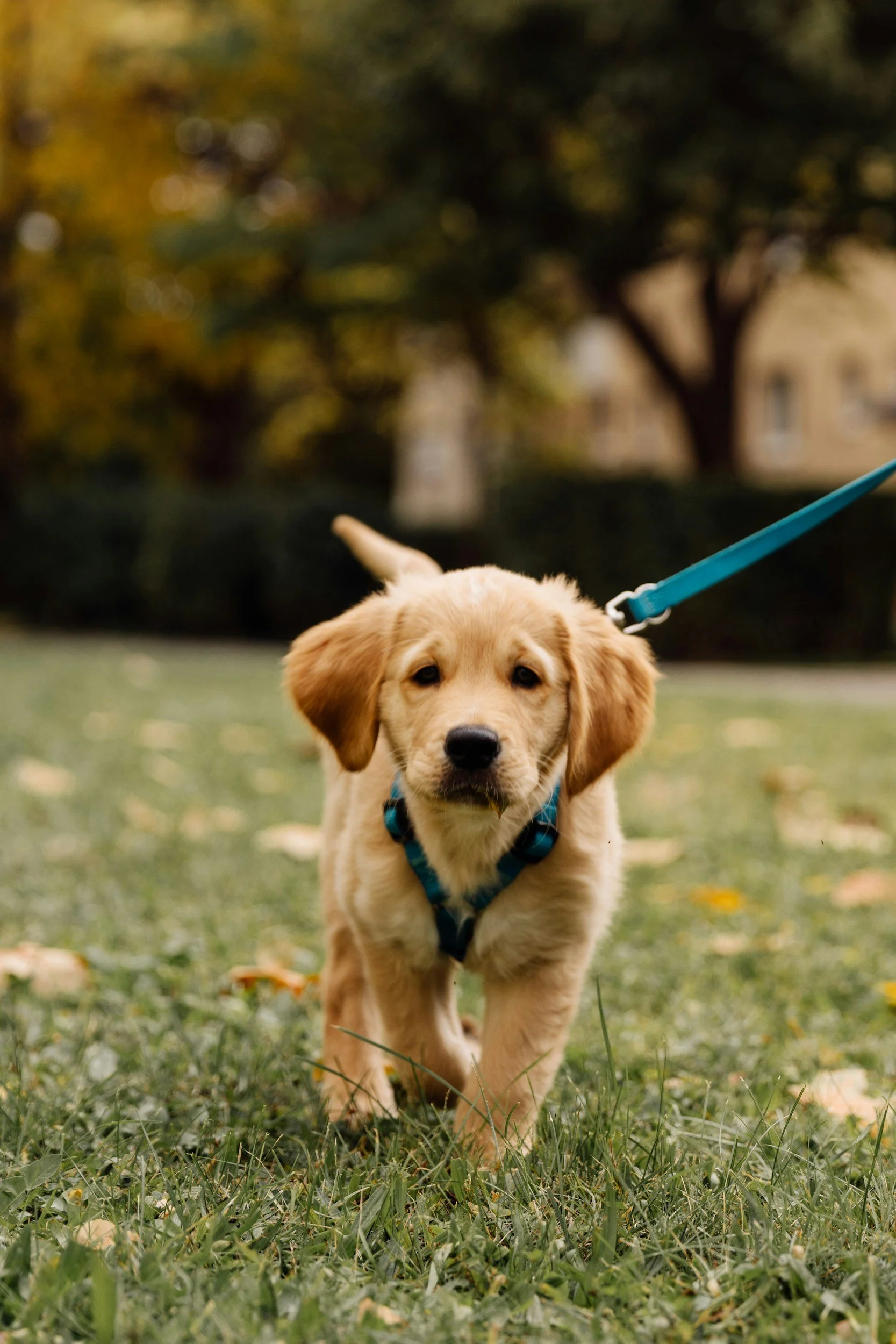
It’s important to consider the puppy or dog who is in front of you when you select where you’ll be training and what you’ll be working on in that particular session. Training is fluid. Ever-changing. Photo: A Golden Retriever puppy walking toward camera wearing a blue harness and leash. It is walking on a lawn with autumn leaves scattered around it.
Practice on-leash recall
You want a dog who comes when called and you want them to come back the first time you call them.
Like any command, you need to practice it in many different places so your dog learns that no matter where you are (parent’s house, your backyard, at the cottage, etc,) “come” means “come right now.”
If you’ve been working on on-leash recall with your dog inside your home, at puppy class, and while you’re out on your neighbourhood walks, you’re likely ready to add in some new locations to proof your recall.
Remember to keep the leash on so your dog can’t ignore you.
When your dog is listening well on the leash, you may switch over to a longline and do some reps that increase the distance between you and your dog, while sill obeying the leash laws.
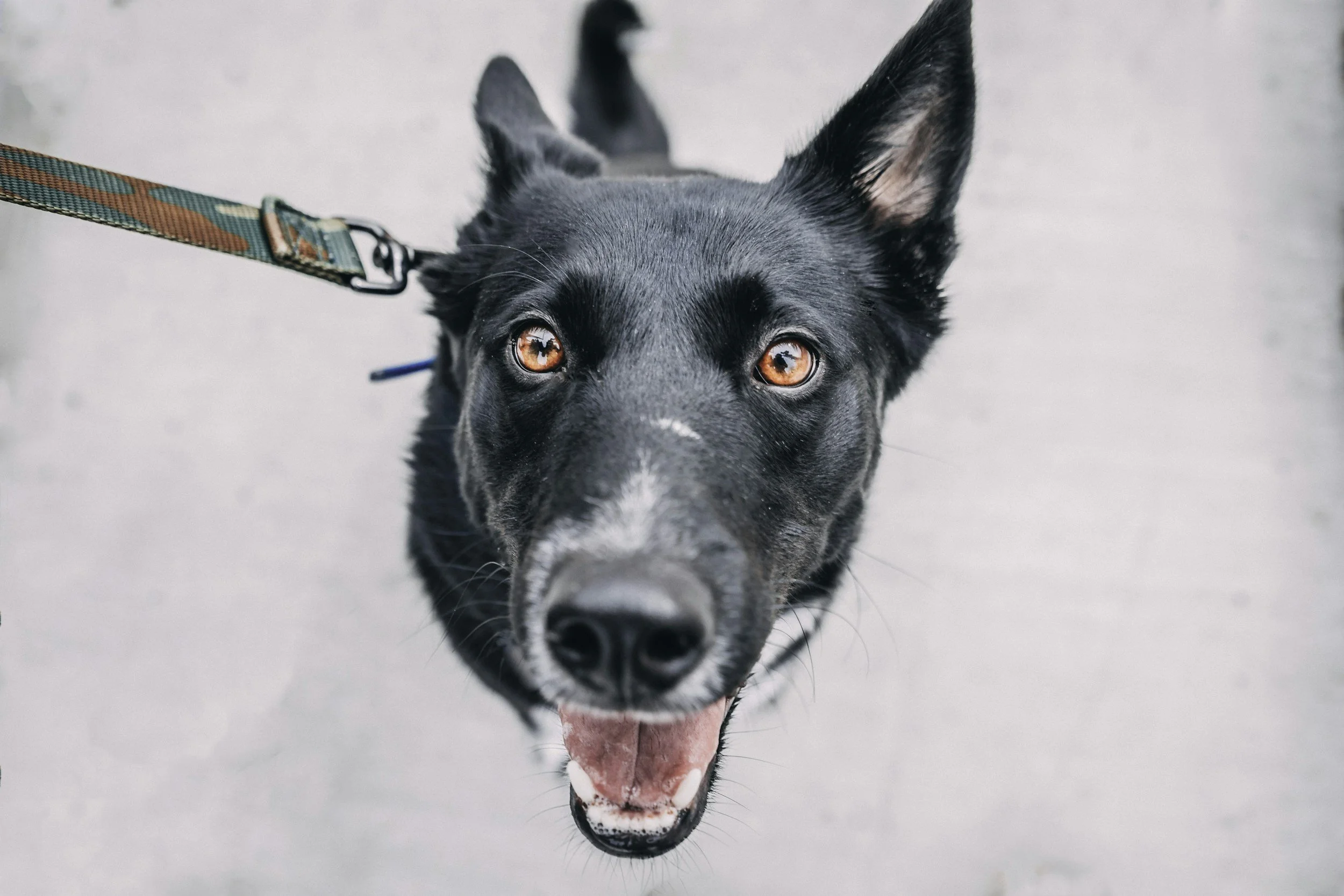
If you want your dog to listen to you when you call — practice, practice, practice. Photo: A black and white dog wearing a green and brown leash looking up to the camera with brown eyes.
Practice placework
You and your dog have been working on placework in your home and in your yard. Your dog understands that her job is to relax on her place cot around indoor and outdoor distractions. You feel ready to practice around some more challenging real-life distractions, like bikes and joggers.
You’re adding a distraction, so your other two D’s (duration and distance) need to decrease. What this means is that you’re about to challenge your dog with more distractions, so you need to do shorter place reps and not move as far away from your cot as you may be able to do at home.
If this is your first time practicing placework out in public, make sure you’re far enough away from the distractions. You don’t want to make your dog a sitting duck as joggers and bikes come flying toward her.

Practicing placework indoors and outdoors helps our dogs learn how to settle no matter what distractions are going on around us. Photo: Beyond Dog Training client, Catherine, practicing placework with her dog, Jasper, on the lawn of their home. He is laying down on an elevated dog bed with his paws draped over the edge. He is a beautiful Shepherd mix.
Practice engagement
If your goal is to have a dog who can listen to you when you’re out in public and who doesn’t yank your arm out of its socket when you’re walking, you’ll want to be the most interesting thing in the environment.
You don’t need to run constant obedience commands the entire time you’re outside with her. Another way to engage with your dog is through play. You can play tug while on leash. You can even play fetch, you’re just not throwing the toy far away.
These games keep your dog interested in you instead of becoming overexcited by everything else in the environment.
Teach your dog how to play with you inside your home first, so you have rules in place that keep the game fun and safe for both of you, before trying it out in public.
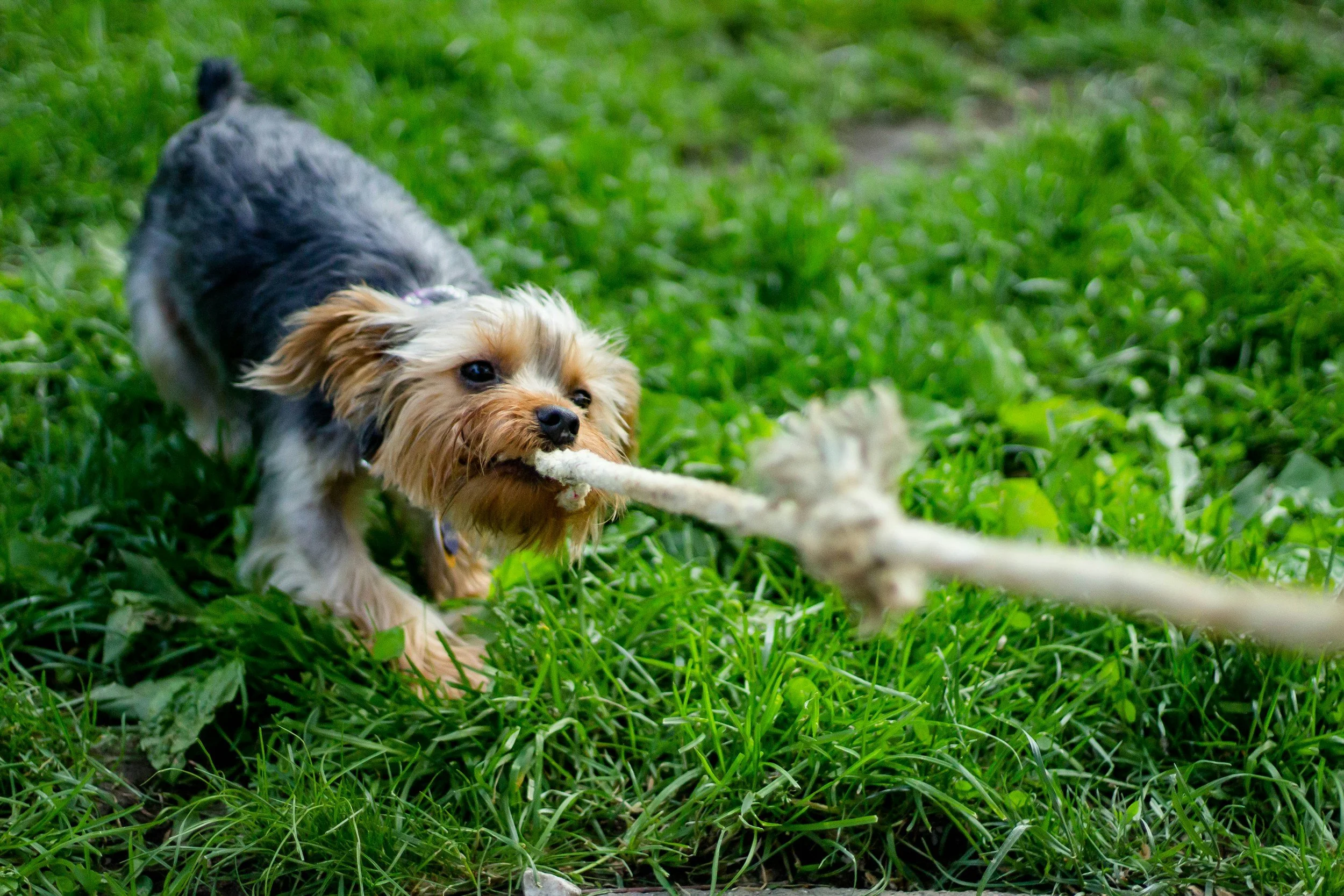
Play is a fantastic way to keep your dog engaged with you instead of blowing up at things in the environment. Photo: A Yorkshire Terrier tugging on a rope. The dog is outside on the grass.
What If Your Dog Is Reactive?
If your dog barks, lunges, growls, or completely loses control when another dog or person appears, a busy Guelph trail isn’t the place to begin helping her through her reactivity.
If your dog is overwhelmed, repeatedly putting her into situations where she explodes gives her more opportunities to practice the exact behaviour you're trying to change. And as we know, what we practice, we get very, very good at.
Making sure your dog feels calm and understands commands inside your home and in your yard can’t be overlooked. Don’t rush to get her out in public. Focus on your foundational skills at home and build up from there. Helping a dog overcome reactivity is a marathon. Not a sprint. Take your time and be sure to celebrate the little wins along the way.
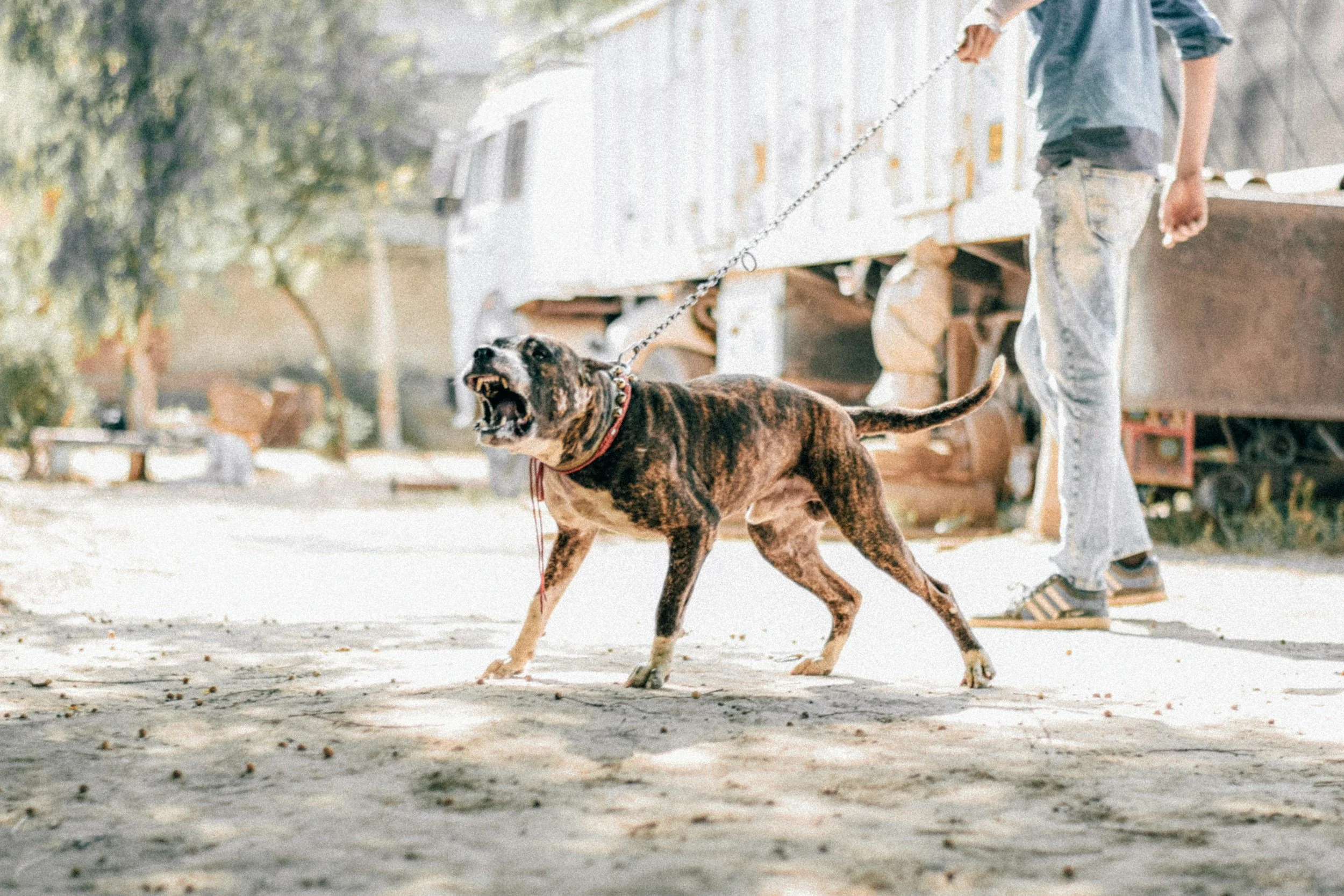
Working through reactivity takes time and patience. Be sure to celebrate the little wins along the way. Photo: A brindle dog barks and pulls on the leash as the person walking them tries to walk forward. The person’s arm is being pulled back and to the left, as the dog fixates on whatever made it bark.
Remember Your Leash
Dogs generally need to remain leashed on Guelph's trails unless you're in a specifically designated leash-free area.
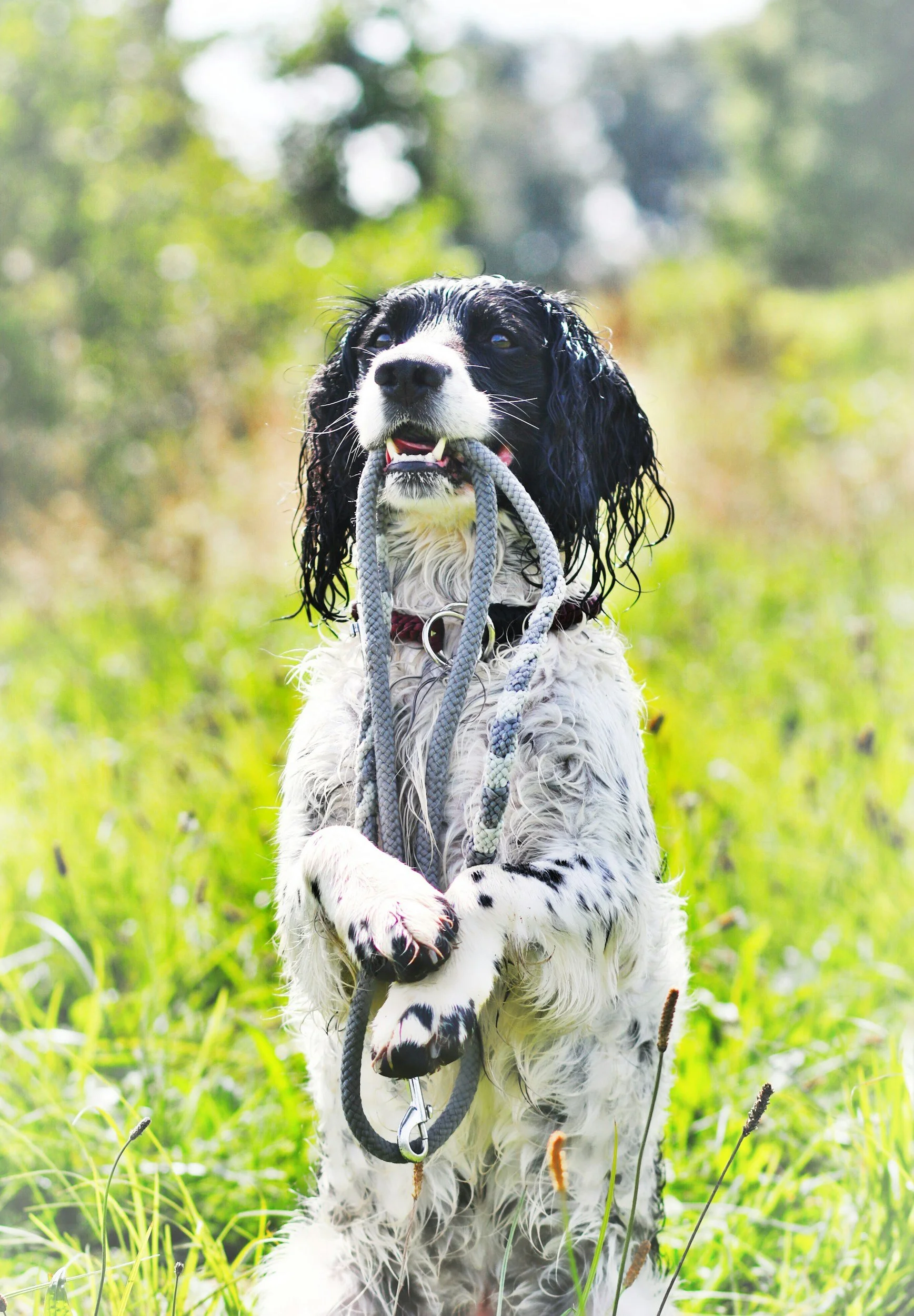
If you dread walking your dog because of how much she pulls, check out our Calm Dog Package. Photo: A wet, black and white Spaniel, sits pretty while holding her leash in her mouth.
Imagine What Your Walks Could Feel Like
Imagine walking along the Speed River with your dog beside you.
A bicycle approaches from behind.
You don't tense up.
You don't wrap the leash around your hand three times.
You don't start scanning for an escape route.
Your dog notices the bicycle.
And then keeps walking.
A dog appears ahead.
You don't panic.
Your dog doesn't explode.
You simply continue enjoying your walk.
THAT is what we're working toward.
Dog training isn't about having a dog who performs perfectly in your living room.
It's about having a dog you can enjoy living your life with.
And Guelph's trails give us some wonderful places to practice.
If your walks currently feel more stressful than relaxing, you don't have to avoid trails forever.
Your dog can learn.
You can feel confident again.
And those peaceful walks you're imagining can become part of your normal life.
At Beyond Dog Training, we specialize in in-home dog training in Guelph and the surrounding area. We help families work through leash pulling, reactivity, fear, puppy challenges, and other behaviours that can make everyday life feel stressful.
Curious about what behaviour problems in-home dog training can help with? Check out this blog post: https://beyonddogtraining.ca/news/what-behaviour-problems-can-in-home-dog-training-help-with
We hope to see you out on (or beside) a Guelph trail one day soon.
Alyssa

Your walks can get better. Photo: Alyssa Foulkes, walking her Rottweiler, Magic, on a Guelph trail. The trail is narrow and there are wildflowers growing on either side of it.
About the author: Alyssa Foulkes is Guelph’s in-home dog training specialist who is recommended by veterinarians. She holds an MSc from the University of Guelph where she studied animal behaviour and nutrition.
Photos by: Upsplash Images and Alyssa Foulkes