

If you’re looking for the best dog trainer in Guelph, this blog post will help you. Photo: a woman presses her hands on her temples as she looks at the laptop on her desk
If you're searching for the best dog trainer in Guelph, chances are you're not looking for someone to teach your dog a few tricks.
You're looking for someone who can help you solve a real problem.
Maybe your dog is barking at every sound in the neighbourhood. Maybe walks have become stressful because of pulling or reactivity. Maybe your dog bolts through the front door, jumps on guests, counter surfs, or simply won't settle down in the house.
Whatever challenge you're facing, one thing is certain: you want results.
The problem is that finding the right dog trainer can feel overwhelming.
A quick search for "dog trainer Guelph" produces dozens of options. Group classes. Board and train programs. Online courses. Trainers using completely different methods and making completely different promises.
How do you know who to trust?
More importantly, how do you know which type of training will actually help your dog?

It’s easy to feel overwhelmed when searching for a dog trainer. Photo: a woman with long hair sits with her hands on her cheeks as she looks at her laptop screen.
Let's walk through what to look for when choosing a dog trainer and why more and more owners are discovering that in-home dog training is often the fastest path to lasting results.
If you're searching for the best dog trainer in Guelph, start by looking for someone with experience in canine behaviour, proven client success stories, and a training approach that works in real-life situations rather than only in classroom settings.
That last point is more important than most people realize.
Many behaviour problems don't happen in a training facility.
They happen in your home.
Your dog isn't barking at the training centre window.
They're barking at the window in your living room.
They're not charging the front door at a training class.
They're charging your front door when deliveries arrive.
They're not reacting to dogs while standing in a classroom.
They're reacting while walking through your neighbourhood.
This is one of the biggest reasons why in-home dog training can be so effective for struggling owners. Training takes place where the behaviour actually occurs, allowing the trainer to see the problem firsthand and create practical solutions for your everyday life. Trainers who work inside the home can address behaviours in the environment where they naturally happen, rather than trying to recreate those situations somewhere else.
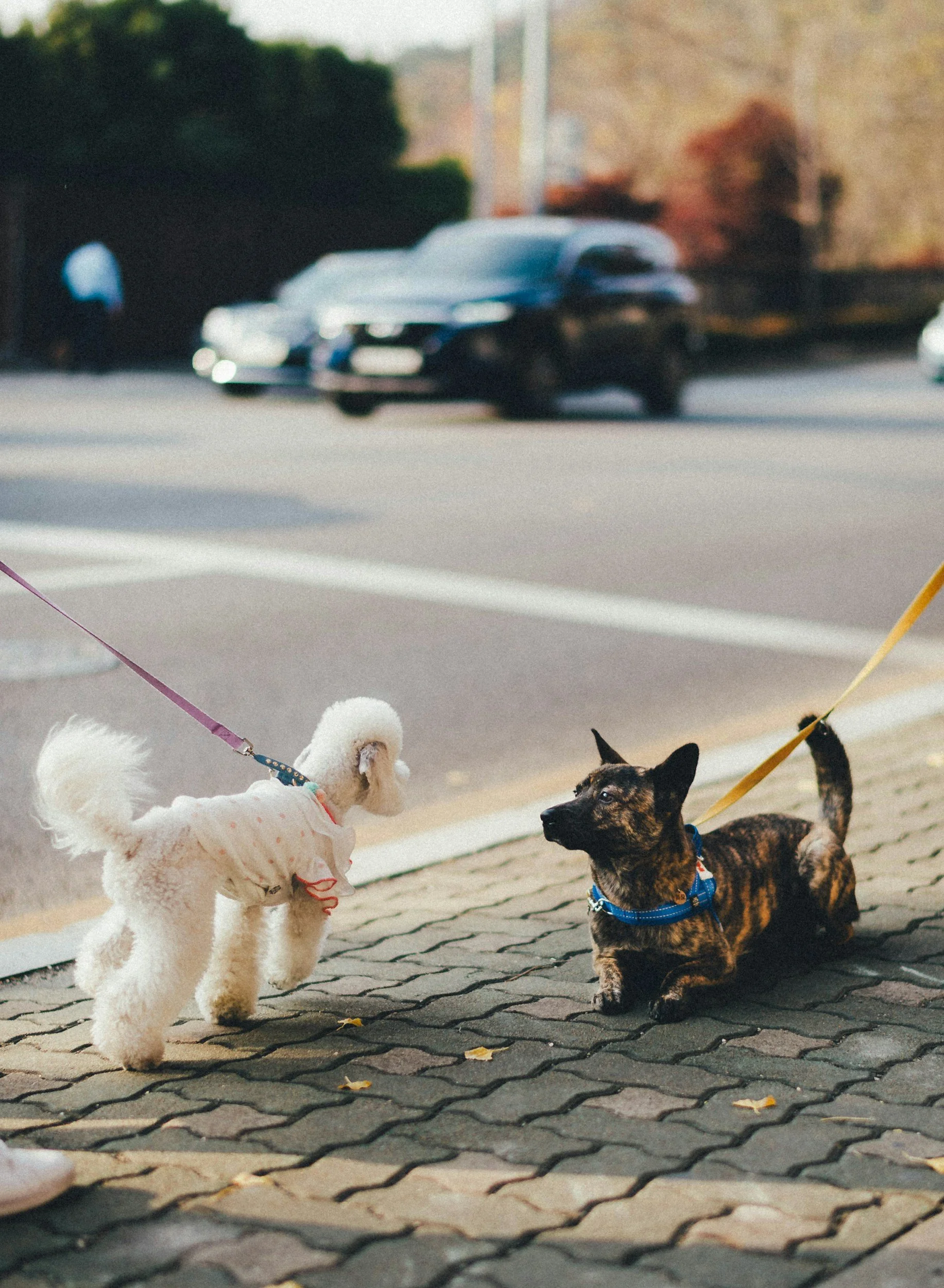
Many owners find that in-home dog training is the most effective way to solve their real-world problems because the work happens in their home and in their neighbourhood, where the problem behaviours are occurring. Photo: Two small dogs face each other on a sidewalk.. Both are wearing leashes.
When evaluating trainers, ask yourself an important question:
"Can this trainer help me achieve the life I want with my dog?"
A good trainer doesn't just focus on obedience.
They focus on outcomes.
Do you want a dog who can relax while guests visit?
Do you want peaceful walks?
Do you want to stop feeling stressed every time someone knocks on the door?
The best trainers connect training exercises to real-world results.
That's why client success stories matter so much.
Look for reviews that describe specific transformations. A dog that stopped barking out the window. A dog that can now walk calmly on leash. A family that can finally have visitors over without chaos.
Those stories tell you far more than marketing claims ever will.

When looking for a trainer, read their reviews and testimonials to find a trainer who has solved the issues you need solved. Photo: a woman wearing glasses points to her laptop screen. Her phone is sitting on the white desk.
Another important factor is whether the trainer takes the time to understand your goals.
Every dog is different.
Every family is different.
The trainer who worked well for your neighbour's puppy may not be the right fit for your reactive adolescent dog.
Quality training should be tailored to both the dog and the owner. One-on-one coaching allows a trainer to focus entirely on your dog's unique challenges, learning style, and environment rather than delivering the same solution to everyone.
It's also worth paying attention to what happens after the training session ends.
Many owners feel motivated during a lesson but become unsure once they start practicing on their own.
The best trainers provide ongoing guidance, accountability, and support between sessions. That support often makes the difference between temporary improvement and lasting success.
As you're researching trainers, don't be afraid to ask questions.
How do they assess behaviour problems?
What does a typical training plan look like?
How do they help owners maintain progress after sessions?
Can they provide examples of similar cases they've successfully worked through?
A professional trainer should welcome these conversations and be transparent about their process. Experts recommend looking for trainers who can explain their methods clearly, answer questions openly, and demonstrate a thoughtful approach tailored to the individual dog rather than relying on one-size-fits-all solutions.

Your trainer should care about your specific goals with your dog and be happy to answer all of your questions. Photo: a happy woman with brown hair talks on her cellphone while sitting on a grey couch.
One mistake many owners make is assuming that group classes are automatically the best place to start.
Group classes can certainly be valuable for some dogs and owners. However, if you're dealing with barking, leash reactivity, anxiety, door dashing, fear, or household behaviour problems, private training is often the more efficient option because the trainer can focus specifically on the issues you're facing. Behaviour challenges such as barking, fear, separation anxiety, jumping on visitors, and reactivity are frequently addressed more effectively in the home environment where they occur.
The reality is that dog training isn't just about changing your dog's behaviour.
It's about changing your daily life.
The right trainer helps you feel confident.
They help you understand your dog.
They provide clarity instead of confusion.
And they create a plan that fits your real-world routine.
Imagine being able to answer the door without chaos.
Imagine enjoying a peaceful walk around your neighbourhood.
Imagine having guests over without worrying about what your dog might do.
That's what good training should deliver.
Not just better behaviour.
A better relationship with your dog.
If you're looking for the best dog trainer in Guelph, take the time to find someone who understands canine behaviour, has a proven track record of helping owners achieve real results, and works with dogs where life actually happens.
Because the goal isn't to have the best-behaved dog in a classroom.
The goal is to have a calm, confident, well-behaved dog in your home.
And that's exactly where the training should begin.
About the author: Alyssa Foulkes is Guelph’s in-home dog training specialist who is recommended by veterinarians. She holds an MSc from the University of Guelph where she studied animal behaviour and nutrition.
Photos by Upsplash.